
Index
An interface automation may stop when the source system changes. Before hiring a replacement, identify whether the failure is one-off, recurring or a consequence of an approach that no longer meets the process.
How to evaluate this decision
Gather successful runs and failures with enough context to reproduce the issue. Separate screen change, expired credential, unavailability and changed business rule. Check if there is an official alternative by API or file. The choice must compare stability, maintenance and access limits, without circumventing automated system controls.
Criteria for comparing proposals
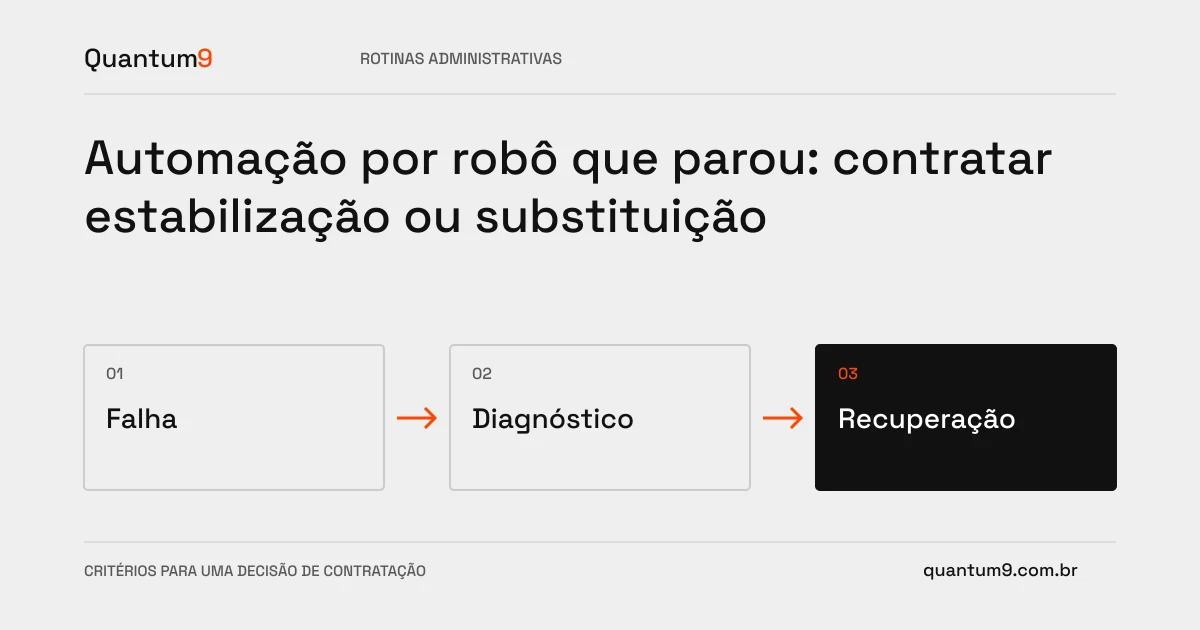
- Diagnosis: locate the interrupted stage and the status of partially processed records.
- Recovery: Prevent duplication when resuming and forwarding exceptions that require human verification.
- Support: Document dependencies, monitoring, and change notice assignees.
A scenario to discuss with the supplier
Hypothetical example: robot creates an order and fails before registering local confirmation. Rerunning everything may duplicate the operation. The correction needs to reconcile the previous result before trying again.
What to validate upon delivery
Repeat outage scenarios and check the status on both systems. An isolated running execution does not prove stabilization; include conditions that caused failures and a recovery procedure.
Prepare the conversation about the project
Quantum9 can assess the existing flow and propose stabilization, official integration or gradual replacement. Provide documentation, authorized permissions, and anonymized examples of recurring failures.
Process automation · Map the company's priority