
Organize billing, write-off and reconciliation before hiring financial automation. See scope, exceptions, and approval controls.
Index
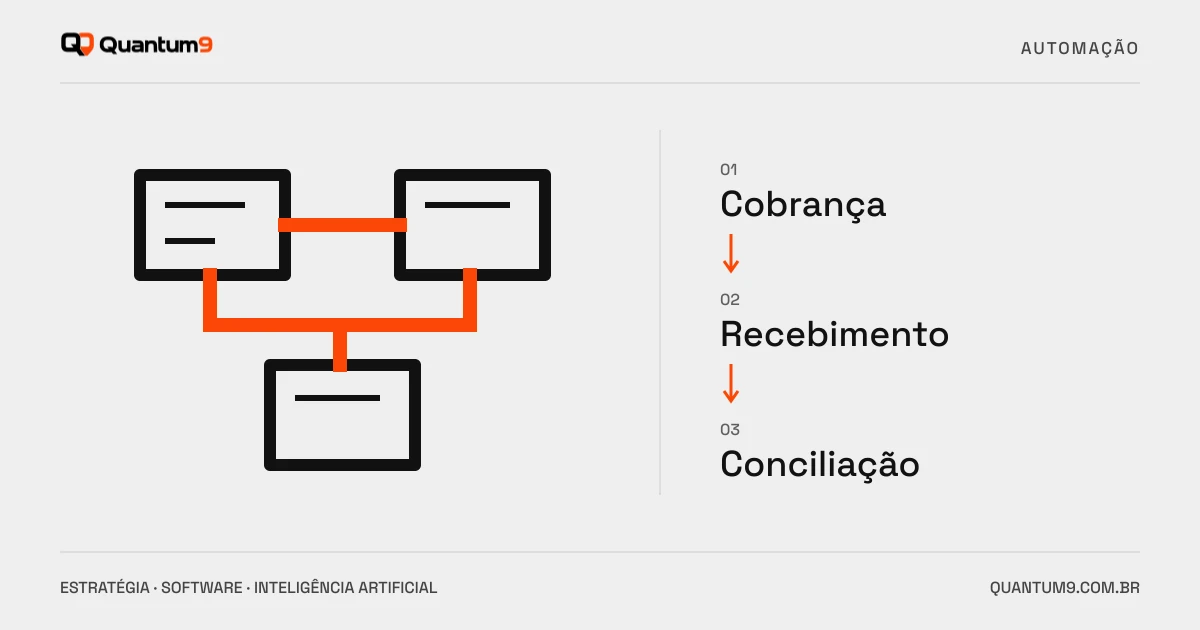
Automating accounts receivable requires separating three events: issuing a charge, receiving a payment and identifying which item was settled. A message sent does not prove receipt. A bank return without a correct link should also not lower a debt by approximation.
Start with the official title source
Record where customers are located, due dates, values and renegotiations. If spreadsheet and ERP diverge, first resolve the responsibility for updating each data. Then choose a limited flow, such as reconciling identified receipts from a specific account. This provides a measure of accuracy before scaling up automation.
Exceptions need to be in the budget
Partial payment, excess amount, interest, discount, refund and receipt without identification are not subsequent details. The proposal must say what happens in each case: automatic download, review queue or blocking. Relevant financial decisions require authorization compatible with the role of the responsible person.
- Avoid double discharges when the same event arrives again.
- Maintain the link between billing, payment and accounting records.
- Record the person responsible, origin, time and reason for each change.
- Allow checking and correction without deleting history.
How to demonstrate that delivery works
Select a sample with normal cases and exceptions, validate the expected result and run the flow in a controlled environment. Compare totals by account and period, plus individual title matching. A correct aggregate total can hide compensations between wrong casualties.
When to use AI and when to use rules
Bank identifiers and settlement rules require deterministic processing. AI can assist in classifying descriptions or preparing a response, but it should not replace authorization and reconciliation controls. Ask the supplier to explain where inference exists and how improper write-off is prevented.
Documents to request the proposal
Inform the systems, payment methods and accounts involved; prepare anonymized sample returns and estimate volume. Compare the cost of deployment with monitoring, support and maintenance of integrations. To connect these flows to the ERP, see also our integrations service.