
Index
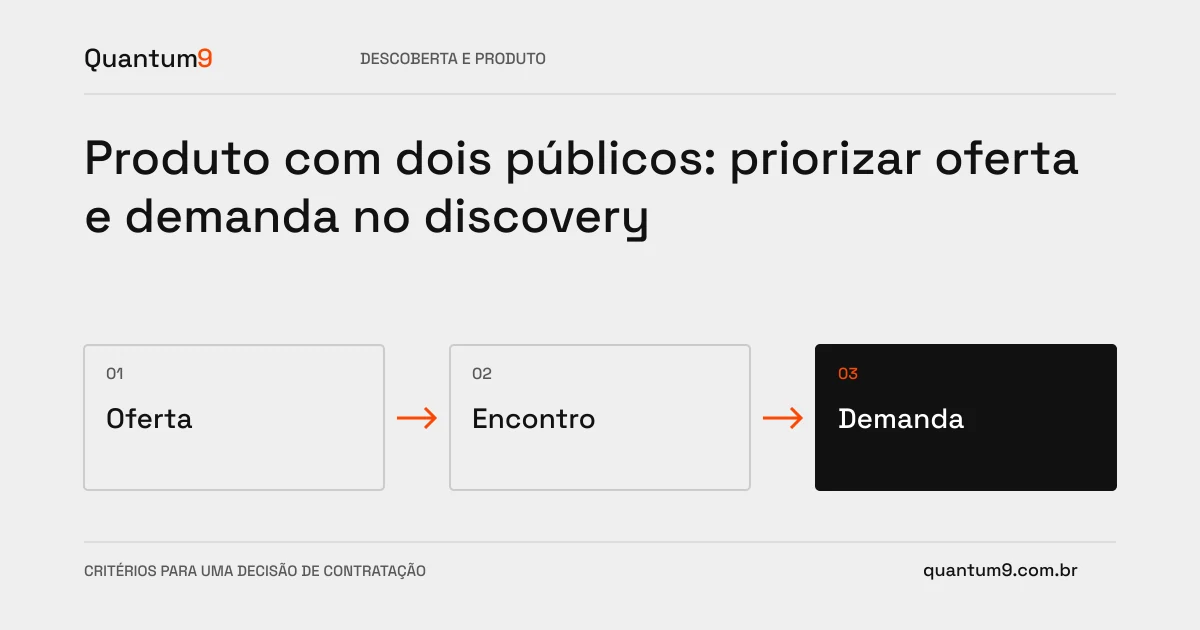
A platform that connects two audiences needs to work for both, but that doesn't mean building all journeys at the same time. The first cut must test the interaction that creates value between the parties.
How to evaluate this decision
Map out what each audience offers, seeks and needs to trust before participating. Identify which side limits the start of the operation. In some scenarios, manual assisted fulfillment can test the relationship before automating the entire journey. Avoid interpreting registrations as proof of market when no useful interaction takes place between participants.
Criteria for comparing proposals
- Proposal: define the specific benefit for each side and the necessary conditions for it to occur.
- Operation: record who resolves conflicts, inconsistencies and requests that the product does not yet meet.
- Measurement: observe useful matches, journey completion and dropout reasons, as well as records created.
A scenario to discuss with the supplier
Hypothetical example: a portal connects providers and companies. Attracting many providers does not validate the product if buyers cannot find compatible availability. The driver needs to test this encounter, even with a limited region or category.
What to validate upon delivery
Ask discovery to propose a sequence of experiments with continuity decisions. Check whether the plan considers the acquisition of both audiences and the ability to operate exceptions without promising non-existent automation.
Prepare the conversation about the project
Quantum9 can help narrow down the initial interaction and the software needed to observe it. Bring the audiences, the expected transaction and the channels through which each side can now be reached.
Prototyping and validation · Map the company's priority