
Index
A usability test should look at whether the audience can complete a task, not just whether they like the screens. Hiring starts with a journey and criteria to recruit participants compatible with it.
How to evaluate this decision
Choose tasks without revealing the expected path. Differentiate between difficulties in understanding, interface errors and prototype limitations. Internal participants may know rules that a new customer does not; therefore, they do not automatically replace the real audience. Agree on how to record sessions, preserve personal information and transform findings into decisions, without presenting a small sample as a statistical estimate of the entire population.
Criteria for comparing proposals
- Recruitment: define the experience, role and context of the participants, avoiding selecting only those who have already mastered the product.
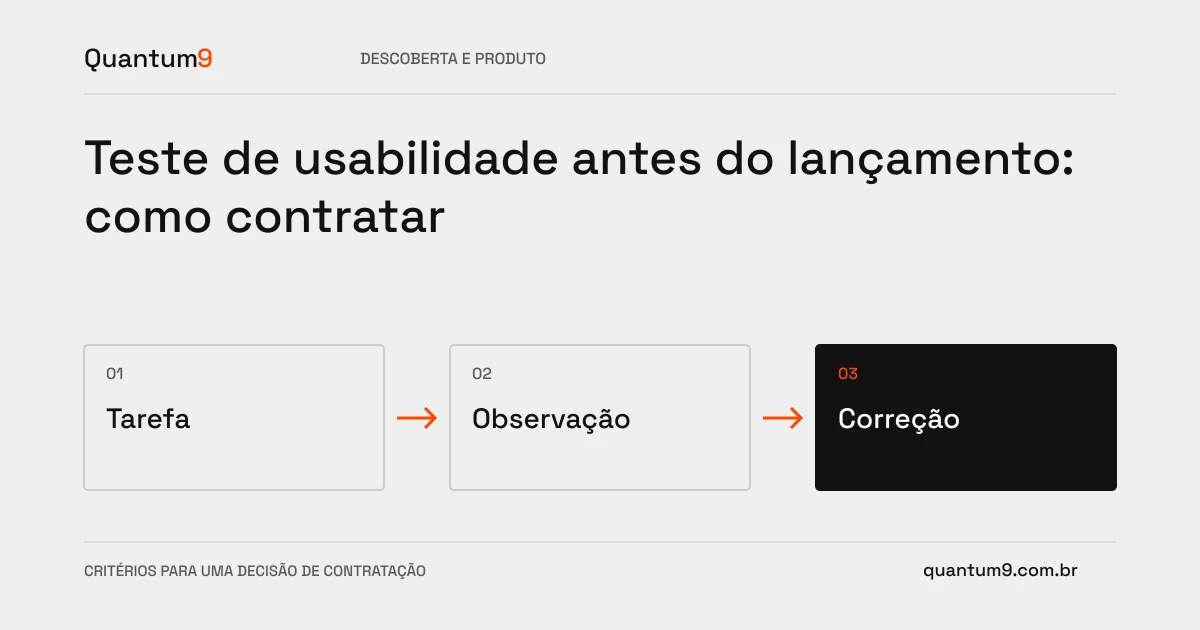
- Roadmap: include the main task, an exception and an error recovery attempt.
- Report: link each difficulty to evidence, impact and recommendation, distinguishing observation from interpretation.
A scenario to discuss with the supplier
Hypothetical example: Buyers complete a quote but don't realize they need to submit it for review. The solution may be to make the state and next step clearer rather than adding other functionality.
What to validate upon delivery
Ask for records that allow problems to be reproduced, prioritization and verification of the most relevant corrections. A report with generic opinions about colors does not prove that the journey was usable.
Prepare the conversation about the project
Tell Quantum9 who uses the product, what task needs to work, and what decision depends on the test. If the release already has a date, take time to correct and check the findings before publication.
Prototyping and validation · Map the company's priority