
Index
A design system only reduces inconsistency when components, code, and usage decisions evolve together. Buying a library of screens without defined maintenance usually transfers the problem to the next project.
How to evaluate this decision
Start by inventorying actually shared patterns. An administrative form and a landing page can use the same colors, but require different densities and behaviors. Define the common core and permitted variations. Governance must explain who proposes changes, how impacts are evaluated and how products receive updates without losing existing functionality.
Criteria for comparing proposals
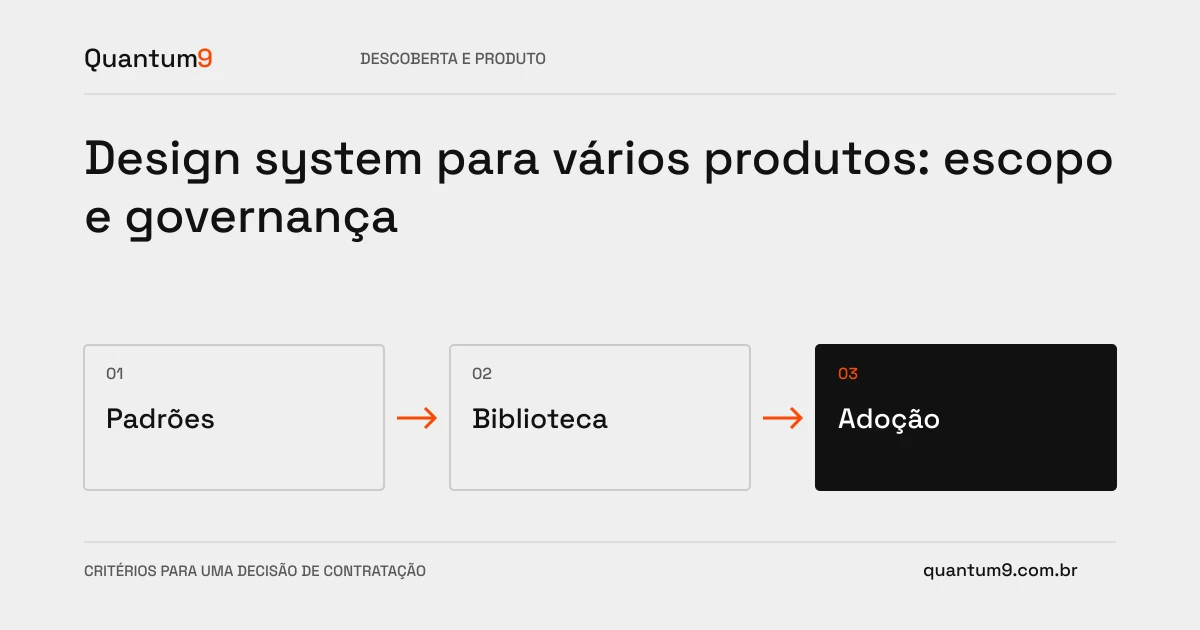
- Fundamentals: document typography, spacing, semantic colors, states and accessibility criteria.
- Components: prioritize the most used ones and provide examples of errors, loading, missing data and keyboard.
- Adoption: include versioning, migration documentation and a pilot product to validate the system.
A scenario to discuss with the supplier
Hypothetical example: Three products have different selectors for the same organization. Standardizing the component requires reconciling search, permissions and context switching; redesigning just the button doesn't solve the behavior.
What to validate upon delivery
Choose a real screen and rebuild it using the delivered library. Check whether undocumented exceptions are required and whether design and implementation produce the same states. Count adopted components, not just designed components.
Prepare the conversation about the project
To delimit the work with Quantum9, present the divergent products, teams, technologies and standards. The first cycle must leave a usable set and an evolution process that fits into the existing operation.
Prototyping and validation · Map the company's priority