
Index
Publishing an app does not end its delivery cycle. Operating system changes, dependencies, and external services require monitoring to keep the journey usable.
How to evaluate this decision
Define who monitors platform warnings, prepares new versions and responds to installation problems. Separate defect correction, adaptation to external changes and functional evolution. The contract also needs to clarify access to publishing accounts and custody of materials needed for the build. The company must be able to transfer the operation without depending on the supplier's personal account.
Criteria for comparing proposals
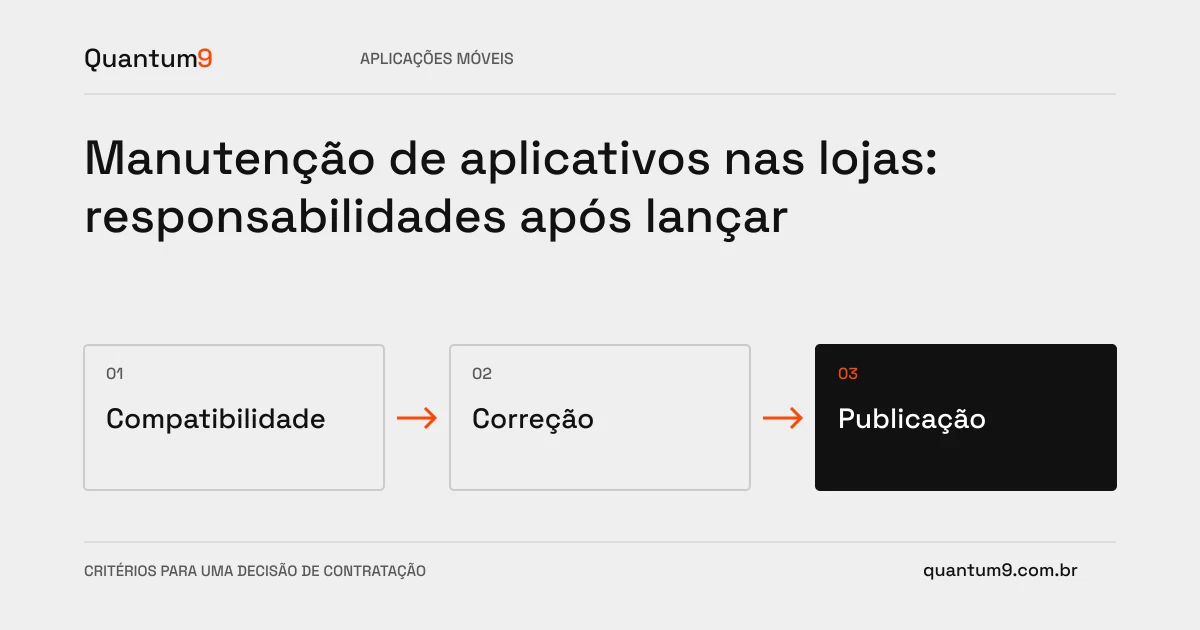
- Compatibility: maintain a matrix of supported devices and versions, with criteria for removing old versions.
- Publication: document preparation, approval, sending and monitoring of release.
- Continuity: preserve code, configuration and build instructions in environments authorized by the organization.
A scenario to discuss with the supplier
Hypothetical example: the API continues to work, but a device update affects the camera. Support needs to reproduce the issue on the platform involved and publish a fix, not just check server availability.
What to validate upon delivery
Request a build replay and a test update using your corporate accounts. Check how incidents are classified and which dependencies can change the deadline. Do not treat third-party review as a deadline entirely controlled by the supplier.
Prepare the conversation about the project
To contract support with Quantum9, inform platforms, users, available code and failure history. The scope must describe coverage, update routine and publication responsibilities without assuming uninterrupted service.
Tailor-made development · Map the company's priority