
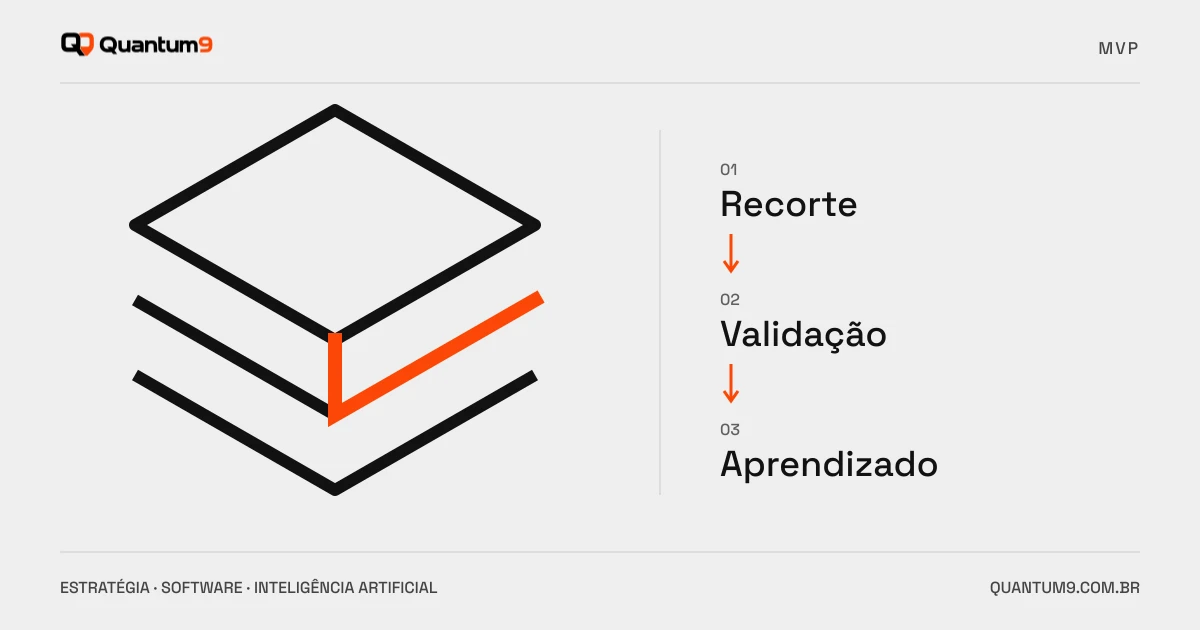
Framework to deliver the minimum viable and validate hypotheses with real users.
Index
Rapid MVP: Focus on actionable learning
The classic mistake is trying to prove the complete vision. MVP is an experiment to test a hypothesis and can combine software, prototype and assisted operation. The central question: "what strategic risk do I eliminate this month?" It could be adoption, technical feasibility or initial monetization.
1. Hypothesis selection
List critical hypotheses (e.g. customers would pay a monthly subscription for automation X). Prioritize by impact if false + ease of testing now. One hypothesis per cycle avoids dispersion and prevents an inflated backlog.
2. Radically Reduced Scope
Map out the ideal journey and mark in red everything that is not strictly necessary to collect signal. This almost always removes fancy dashboards, automated onboarding, and non-essential integrations. What is left becomes a versioned backlog (v2, v3).
3. Sufficient quality
Write code clean enough to allow refinement, but don't over-optimize. Minimal automated testing for main flow + critical failure cases. The goal is to avoid toxic debt, not achieve perfection.
4. Telemetry from day 1
Each key action (account creation, main feature activation, cancellation, wizard abandonment) becomes an event. Without instrumentation you just “think” you learned. Configure simple events via dataLayer + daily reading spreadsheet.
5. Feedback loop
Weekly wheel: build -> measure -> decide. Short interviews with active users (5–7) + metrics analysis -> adjust hypothesis or promote to next phase (UX refinement, monetization, retention).
6. Continuous Delivery
Small, verified deliveries reduce the size of changes; the frequency must respect the validation capacity and the operational context. Feature flags allow you to activate blocks for internal or beta users only.
7. Success criteria
Define beforehand: activation target (e.g. 40% complete key action in 7 days), payment intention (positive response in interviews) or manual time reduction by X%. Without concrete metrics, the team celebrates "launch" instead of learning.
Need to accelerate an MVP with technical governance? We set up a dedicated product, design and engineering cell to deliver a testable version with an evolution path compatible with the scope.
How to turn the topic into a hiring decision
An MVP should test the riskiest hypothesis with the least amount of appropriate effort. Some questions can be answered with prototype or assisted operation before writing software. The choice depends on the signal you need to observe.
What to include in the scope
Define audience, main task, feedback collection and closing conditions. Limit functionality but preserve essential access and data controls. Deadline and team need to follow the real cut.
How to check delivery
Agree criteria before launch: task usage, audience feedback, and pertinent business evidence. Stated intent to purchase is a different signal than payment. Record learning even when the decision is not to continue.