
Index
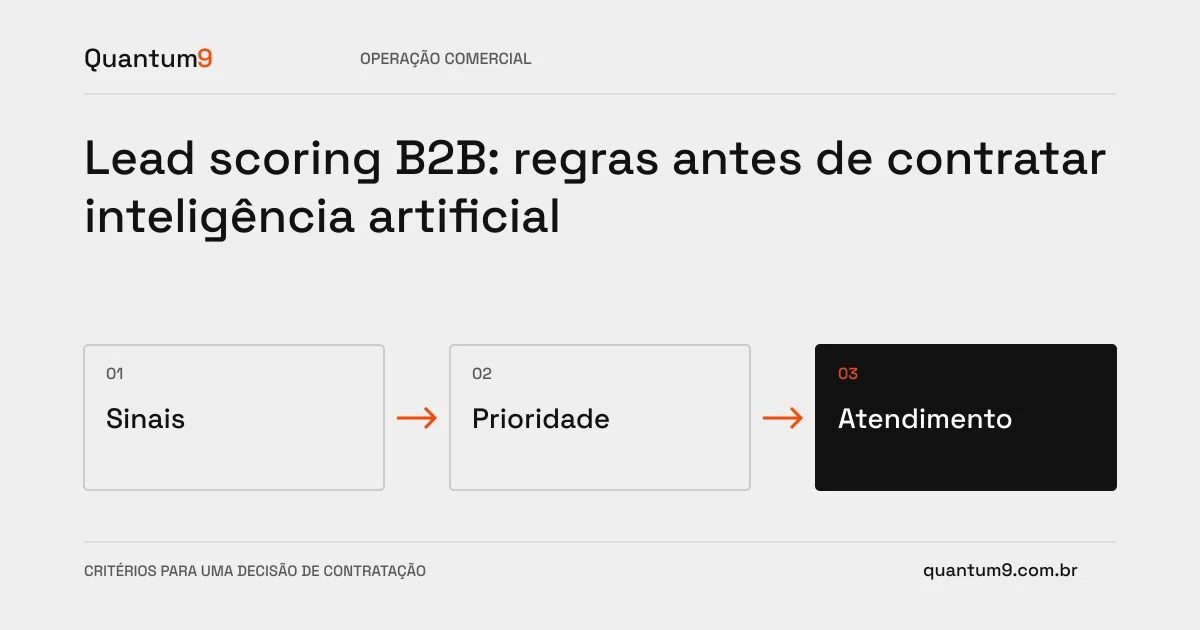
Lead scoring should help prioritize service, not produce a score without consequence. Before using AI, the company needs to define what characterizes a compatible opportunity and what action changes depending on the classification.
How to evaluate this decision
Separate adherence to the observed behavior profile. A contact can consume a lot of content and not need to be hired. Start with explainable criteria and record the results to assess whether the prioritization works. Incomplete data should appear as uncertainty, not automatic disapproval. Avoid sensitive inferences that are not necessary for the commercial decision.
Criteria for comparing proposals
- Criteria: document signs of need, compatibility and timing of purchase.
- Action: relate tracks to service, investigation or monitoring, with the possibility of review.
- Assessment: Compare ranking and actual results by looking at relevant contacts that were left out.
A scenario to discuss with the supplier
Hypothetical example: a decision maker requests specific integration, but has little activity on the site. A rule based only on visits may give lower priority to the closest contact to hiring.
What to validate upon delivery
Apply the model to historical opportunities and a new sample, without immediately changing the entire operation. Register prioritization errors and adjust criteria with the sales manager.
Prepare the conversation about the project
Take to Quantum9 the customer profile, available history and decision that the score should support. The solution can start with simple rules and evolve only when there is data and benefit to justify greater complexity.
CRM and retention · Map the company's priority