
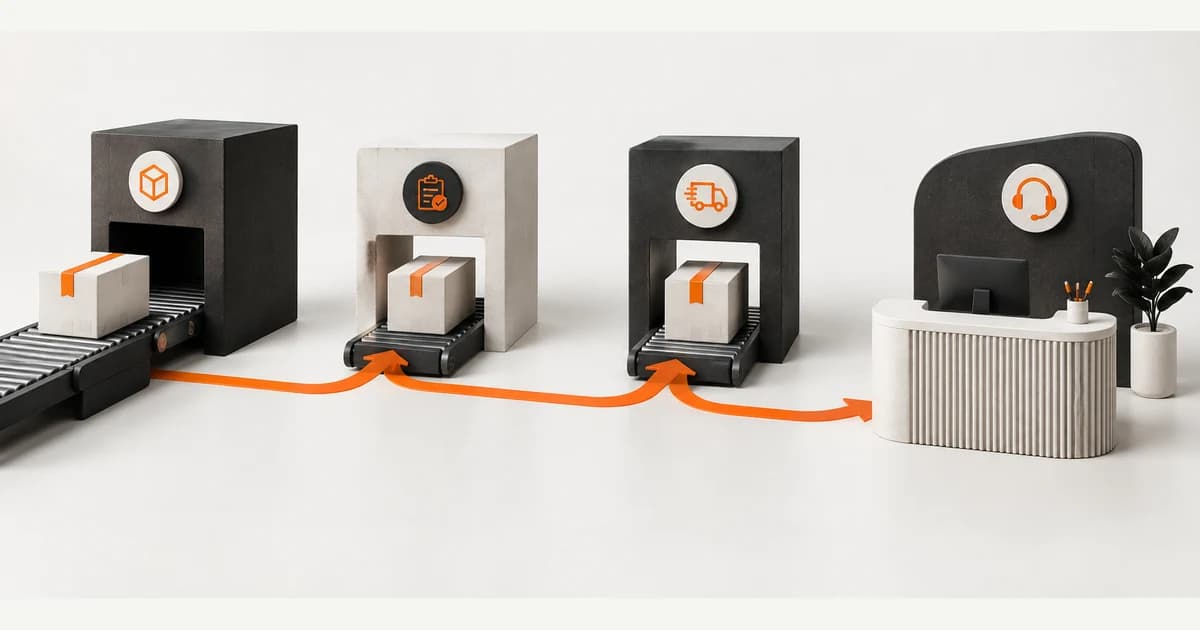
Connect carriers and fulfillment with understandable delivery states, exceptions, and source information to reduce manual order queries.
Index
A list of technical events does not necessarily answer where a request is or who should act. Integrating tracking into service requires interpreting logistical returns carefully. The system must explain the known state and show when information is late, without inventing a prediction.
Decision this guide helps you make: Transform logistical events into useful information for the customer and the team.
Organize events in operational states
Map collection, transit, attempt, occurrence and delivery according to the services used. Preserve the original event and its date for investigation. Avoid converting different situations into a single generic status. An unsuccessful attempt may require a corrected address, new schedule or contact with the carrier, and each case requires escalation.
Set the source of predictions
A prediction can come from the carrier or an internal rule. Identify this source and update the message when it changes. Do not present as confirmation what is still an estimate. The team needs to know whether the latest data reflects the current operation or just the last successful query.
Bring exceptions to an action queue
Service must be able to filter orders without updates, deliveries that occur and cases that depend on the customer. Define responsible parties and operational deadlines appropriate to the contracted service. Integrating messaging channels requires your own consent and configuration; Automatically pushing any updates can increase noise and cost without improving the experience.
Check link and privacy
Tracking must be associated with the correct order, including when there are multiple volumes or partial shipments. External links must not reveal data from other customers. Split test request, improperly reused code and lack of final event. The acceptance must verify what appears to the team and the recipient.
- Preserved events with origin and time.
- Partial shipments linked to the order.
- Occurrences with defined routing.
A scenario to check out in the demo
Hypothetical example: an order comes out in two shipments and only one was delivered. The client's vision should not declare complete completion. Customer service needs to see the pending volume and its latest update to guide the next action. This scenario must be included in the acceptance, especially when the commercial order and logistics codes have a one-to-many relationship.
Briefing to request a proposal
- Carriers and event sources available for integration.
- Rules for orders divided into more than one shipment.
- Occurrences that require action from the customer or team.
Choose the flows with the highest demand
Quantum9 can map contact reasons and connect available providers. Start with the most time-consuming queries and incidents that require action. The expected result is reliable information and clear next tasks, not just an animated map.
Discover the scope of Systems integration and deepen the context in related guide.