
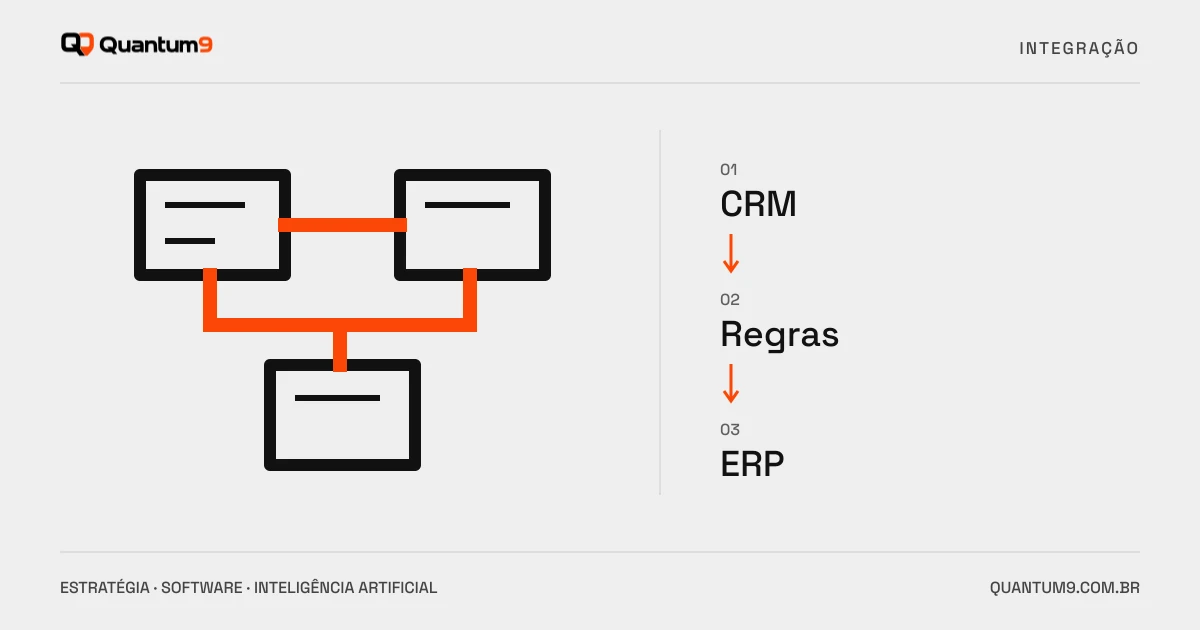
Find out what to look for when contracting the integration between ERP and CRM: data, rules, failure handling and acceptance criteria.
Index
A sale closed in CRM should not depend on someone copying the registration to the ERP. But connecting two systems without defining who is in charge of each information can create duplication, wrong prices and orders without payment conditions. The budget starts with the operation rules, before choosing the tool.
Define the first flow that needs to work
Choose a complete journey: opportunity approved, customer verified, order created and order number returned to CRM. For each step, record source system, required fields, person responsible and blocking condition. Differentiate company registration, contact and delivery address: they do not always represent the same entity.
What changes the cost of integration
Documented APIs and testing environments reduce uncertainty. Systems that require files, brokered access, or vendor approval add dependencies. The scope also includes volume, update frequency, history to be imported and the handling of deletions. Synchronizing two bases in both directions usually requires more rules than sending a request in one direction.
- List versions, vendors, and API availability for each system.
- Define the official source of price, stock, registration and financial situation.
- Separate implementation, third-party licenses and monthly operation in the proposal.
- Agree how future changes to APIs will be supported.
Test failures, not just successful sales
Request a demo with repeat order, incomplete customer and ERP temporarily unavailable. Repetition cannot generate another order; the error needs to be visible; reprocessing must preserve traceability. Acceptance must include verification by someone from sales and someone from billing, using authorized examples or synthetic data.
When not to develop your own integration
If an official connector meets the rules, volume, and support you need, compare its total cost to a custom implementation. Own development makes more sense when there are relevant rules that the connector does not resolve. Before hiring, ask the supplier to explain this difference with a concrete flow from your company.
Prepare a productive conversation
Bring an anonymized request, the current process design and the list of systems. Quantum9 can evaluate dependencies and propose a verifiable first delivery. To delve deeper into technical precautions, also read the guide on APIs and events in systems integration.