
Index
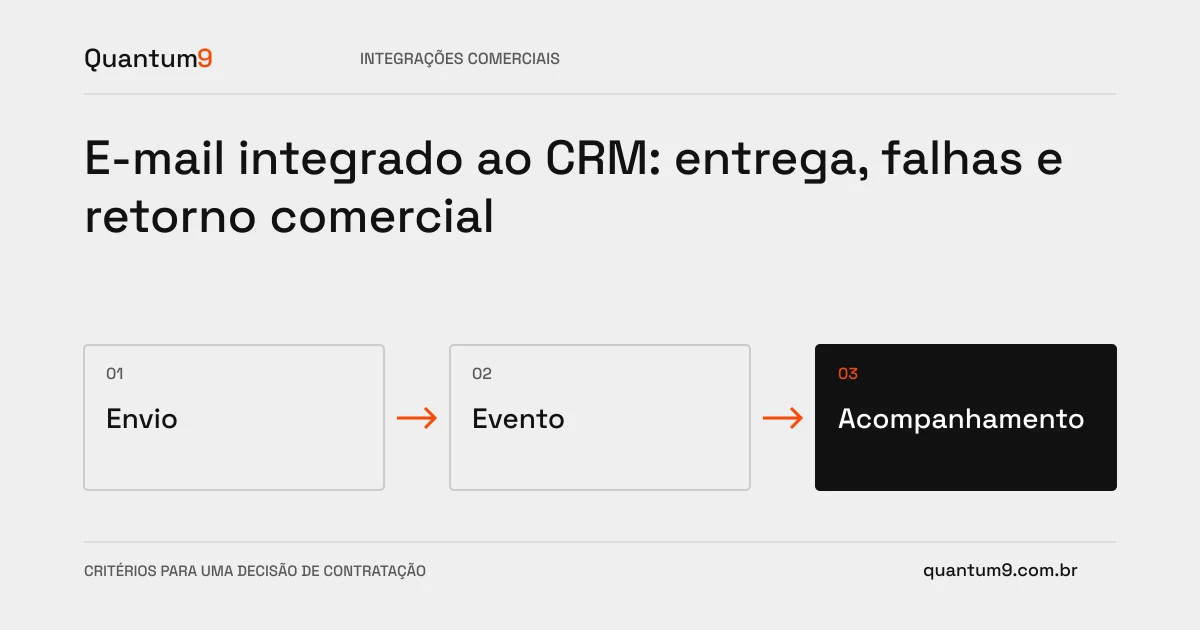
The CRM needs to distinguish a message accepted by the provider from a confirmed delivery or a response from the recipient. Mixing these events leads to unreliable reporting and business automation.
How to evaluate this decision
Map the events offered by the email service and their limitations. Define how permanent failures, responses, and stop requests change tracking. Do not use openness as an isolated proof of interest: privacy and processing mechanisms may interfere with this measure. The operational focus must be on verifiable states and coherent actions.
Criteria for comparing proposals
- Link: relating message, contact and opportunity with stable identifiers.
- Events: validate origin, handle repetition and preserve relevant temporal order.
- Action: suspend inappropriate submissions and forward responses to the correct person.
A scenario to discuss with the supplier
Hypothetical example: the provider accepts the shipment, but then reports a permanent failure. The CRM must update the state and prevent the sequence from continuing to treat the address as a reached contact.
What to validate upon delivery
Test sending, failure, response and duplicate event. Compare the provider's history with the CRM and check that sensitive content does not appear inappropriately in logs.
Prepare the conversation about the project
Inform Quantum9 of your existing provider, CRM and automation. The scope must define which events will be used and what each one actually allows to conclude about the communication.
Systems integration · Map the company's priority