
Index
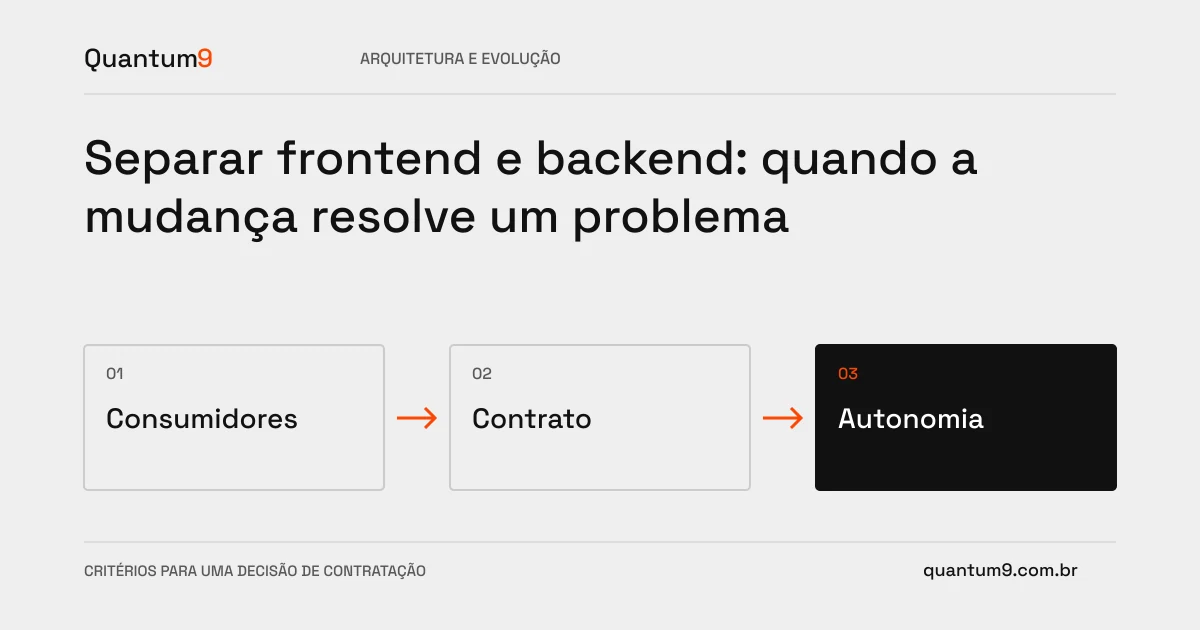
Separating frontend and backend can support independent channels and teams, but it also creates additional contracts and dependencies. The decision must respond to a concrete evolution or distribution problem.
How to evaluate this decision
Identify who consumes the rules and which delivery cycles need autonomy. A public API, application, and portal can justify clear boundaries without requiring rewriting everything at once. Consider authentication, authorization, versioning, and error handling. Moving code to another service does not automatically fix duplicate rules.
Criteria for comparing proposals
- Reason: relate the separation to real consumers or delivery cycles.
- Contract: define necessary operations, data and compatibility between the parties.
- Transition: choosing a journey and maintaining behavior as consumers migrate.
A scenario to discuss with the supplier
Hypothetical example: the application needs the same rules as the portal, currently executed only in the interface. Centralizing validation on the server could be the first step before a larger reorganization.
What to validate upon delivery
Test the journey across all consumers, including direct API attempts. Check permissions and error responses without relying on exclusively visual validations.
Prepare the conversation about the project
Bring your current channels, teams and limitations to Quantum9. The diagnosis must show the expected benefit and cost of maintaining the new contract between frontend and backend.
Software architecture · Map the company's priority