
Index
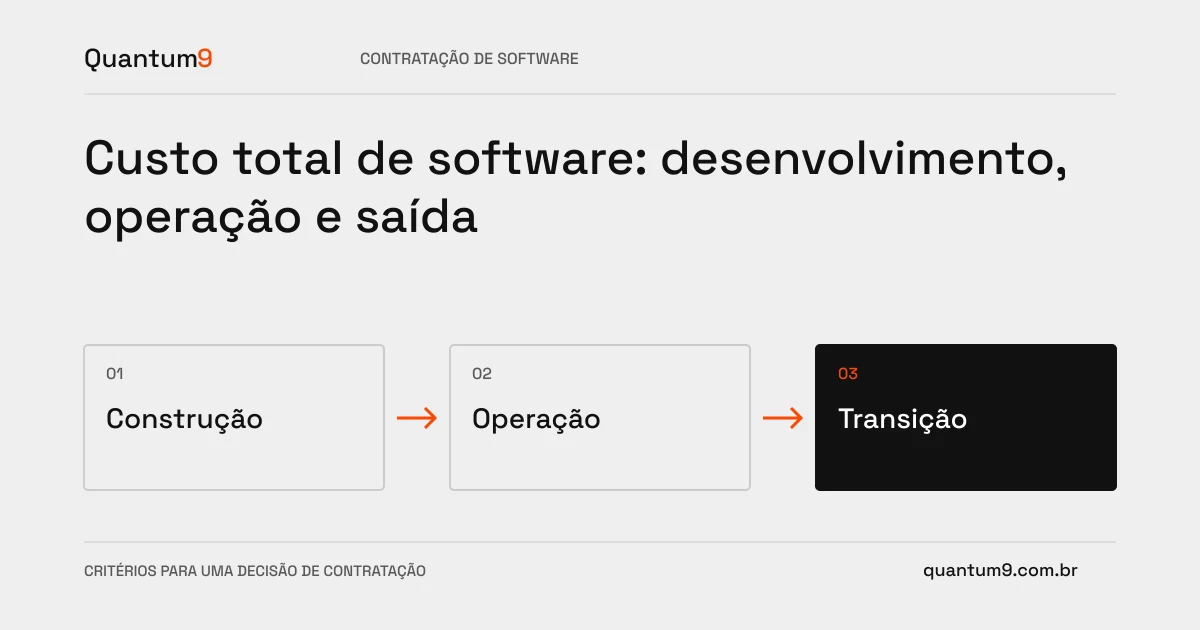
Comparing only the development price can lead to hiring a solution that the company cannot sustain. The budget needs to represent the expected useful life, including implementation, infrastructure, maintenance and eventual replacement.
How to evaluate this decision
Set up scenarios with the same population of users and the same volume of data. Separate initial from recurring expenses and identify charges that vary by transaction, storage or environment. Reserve the decision about growth for explicit assumptions: an optimistic projection should not be treated as contracted consumption. Internal approval, training and administration costs also belong to the comparison.
Criteria for comparing proposals
- Implementation: detail migration, configuration, training and integrations; do not accept that they only appear after hiring.
- Operation: inform billing unit, limits included, adjustments and who monitors consumption.
- Output: provide usable export, documentation and transition support, with separate costs and responsibilities.
A scenario to discuss with the supplier
Hypothetical example: two proposals deliver the same portal. One includes support and export; the other charges these items separately. Compare both during the same usage horizon and simulate an increase in volume. The cheapest subscription option may no longer be the most appropriate for the scenario.
What to validate upon delivery
Ask for a spreadsheet whose formulas can be audited and a list of assumptions that change the total. Redo the calculation with another volume and check if the variable costs respond correctly. The result is used to decide, not to guarantee future expenses.
Prepare the conversation about the project
To discuss the investment with Quantum9, inform users, integrations, current volume, growth expectations, usage time and internal responsibilities. The proposal must separate what is already known from what requires diagnosis.
Software engineering · Map the company's priority