
Index
Promising less rework requires defining what will count as a fix and why. The assessment must compare equivalent tasks and consider changes in volume, staff and the process itself.
How to evaluate this decision
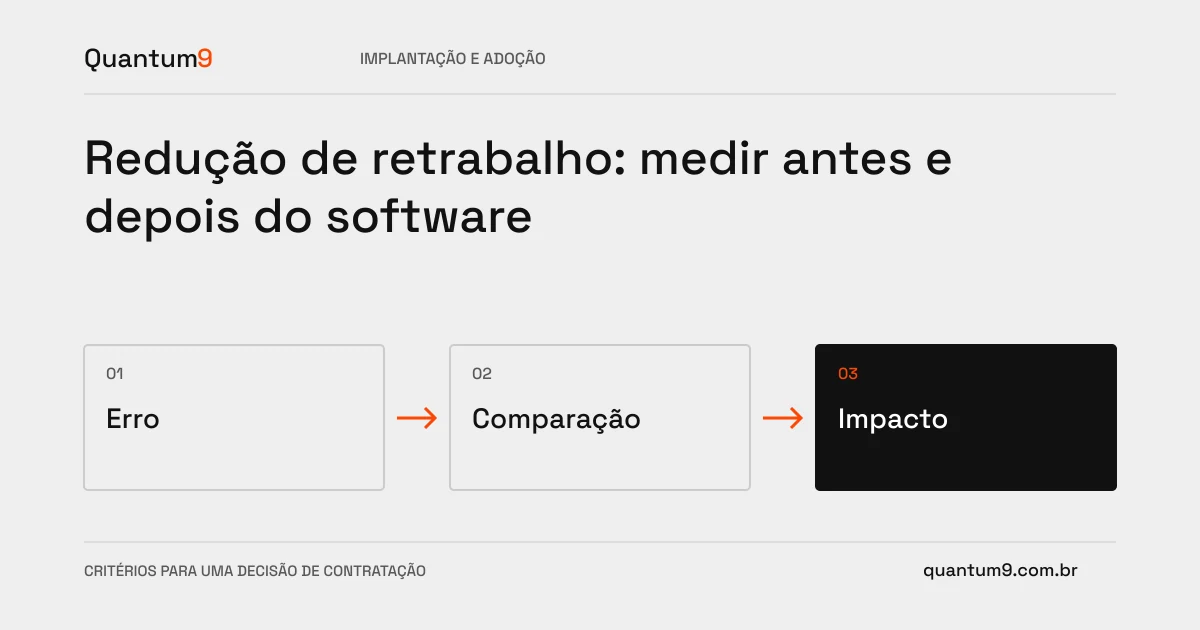
Classify types of rework: incomplete data, duplication, rule error or integration failure. Choose a consistent sample or record and document the method. After the change, use the same definition and note whether the effort was eliminated or just transferred to someone else. Estimated time saved should not be presented as realized financial savings without this validation.
Criteria for comparing proposals
- Definition: distinguishing avoidable correction from necessary review of the process.
- Comparison: consider volume and complexity of tasks in the periods analyzed.
- Effect: monitor quality and load in the following stages, in addition to the automated stage.
A scenario to discuss with the supplier
Hypothetical example: registration is faster, but the financial team needs to correct incomplete information later. Local improvement does not necessarily represent a reduction in rework in the entire flow.
What to validate upon delivery
Reconstruct before and after cases and check effort logs. Show sample limitations and external factors so that the result can guide decisions without becoming an exaggerated promise.
Prepare the conversation about the project
Take the process, error types and available data to Quantum9. The design may include instrumentation to evaluate automation with agreed criteria prior to deployment.
Software evolution and deployment · Map the company's priority