
Index
Continuing a project just because there has already been investment can increase a loss. Continuity criteria help distinguish a recoverable difficulty from a hypothesis that no longer makes sense.
How to evaluate this decision
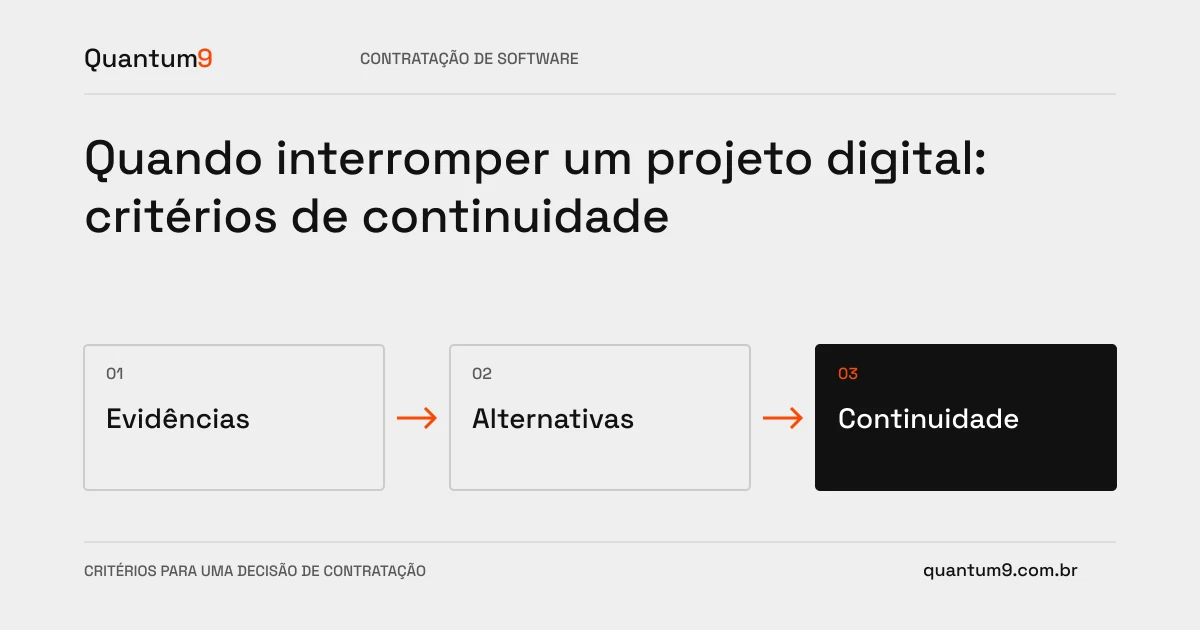
Define milestones linked to evidence: integration feasibility, user participation, adherence to the process and possibility of operation. A milestone should allow you to continue, reduce scope, change approach, or close. The money already spent informs the context, but the main decision compares the remaining investment to the still plausible value. Avoid using an arbitrary date as the only technical criterion.
Criteria for comparing proposals
- Hypotheses: record what conditions need to be true for the next investment to be worthwhile.
- Limits: establish cost tolerance, external dependencies and risks that require management review.
- Closing: ensure documentation, data export and preservation of what is still useful.
A scenario to discuss with the supplier
Hypothetical example: a portal depends on an API that the partner will not make available. The project can be reduced to one stream per file, postponed, or terminated. Building the rest without resolving this dependency does not eliminate the risk.
What to validate upon delivery
In the milestone review, separate observed evidence from expectations. Record the decision, the discarded alternatives and what authorizes a resumption. If the team cannot explain the next verifiable result, it is necessary to reset the cycle before proceeding.
Prepare the conversation about the project
Quantum9 can support a continuity diagnosis with access to scope, deliverables, constraints and dependencies. The work should produce practical options, without assuming in advance that recovering or rewriting is always the answer.
Software engineering · Map the company's priority