
Index
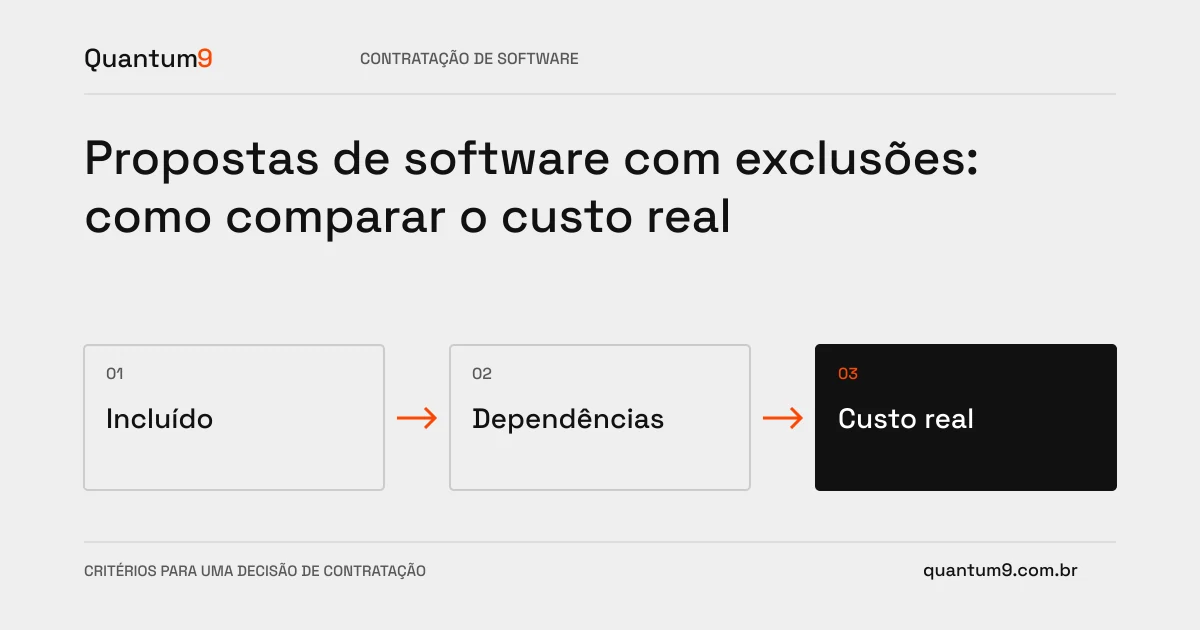
Two proposals can have the same title and hire different work. Before comparing values, transform exclusions and dependencies into a responsibility matrix. This is where delays and additional expenses tend to arise.
How to evaluate this decision
Choose a concrete journey, such as registering an order and sending it to the ERP. For each step, mark who provides the data, implements the rule, tests, and resolves failures. A deleted activity does not disappear from the project: it is now carried out by the customer or another supplier. Add this effort to the analysis, without trying to convert inaccurate estimates into an artificially accurate price.
Criteria for comparing proposals
- Integrations: separate construction of the connector, contracting licenses and granting access by the system supplier.
- Content and data: identify who writes texts, cleans records and approves imports.
- Delivery: Verify that publishing, training, corrections assurance, and initial operation are included.
A scenario to discuss with the supplier
Hypothetical example: a budget includes migrating records, but excludes correcting duplicates. Another includes sanitation of a sample and charges the remainder per batch. Without knowing the condition of the base, there is no equivalence between the offers.
What to validate upon delivery
Request an equalization meeting using the same matrix for everyone. Record written responses and check whether the final version incorporates the clarifications. A verbal presentation should not replace the scope that will actually be contracted.
Prepare the conversation about the project
Send Quantum9 the priority journeys, the systems involved and the activities that your team can undertake. Remove confidential information from third-party proposals before sharing them. The goal is to clarify the work required, not just choose by the smallest number.
Software engineering · Map the company's priority