
Index
PoC, pilot and MVP answer different questions. Choosing the step by the most popular name can produce a pretty demo without reducing the risk that actually stops the business from moving forward.
How to evaluate this decision
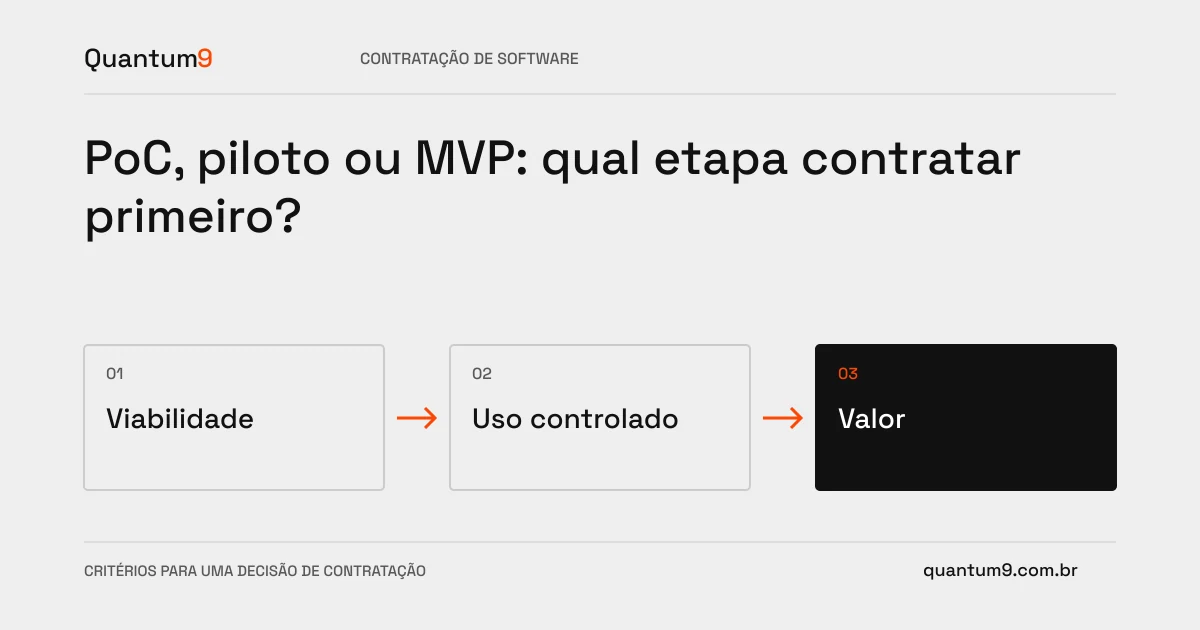
A proof of concept tests limited feasibility, such as reading equipment or integrating an API. A pilot puts a solution into controlled use to observe operation and adoption. An MVP delivers a minimum value proposition to real users. The limits are not rigid, but the contract must declare which question will be answered and what the result does not prove.
Criteria for comparing proposals
- PoC: delimit technology, test data and verifiable result; do not confuse experimental code with a ready-made product.
- Pilot: define participants, duration, support, environment and conditions for stopping use.
- MVP: include the core journey, essential administration and measurement necessary to decide evolution.
A scenario to discuss with the supplier
Hypothetical example: a service depends on communication with a device. First, a PoC verifies this communication. Afterwards, a pilot observes the field work. Only then does it make sense to expand the product and its distribution, if the evidence supports the decision.
What to validate upon delivery
Ask for a closure document that differentiates proven results, limitations, and disposable work. If the supplier promises to reuse everything, ask which parts were built with production requirements and which still need revision.
Prepare the conversation about the project
Bring to Quantum9 the key uncertainty, the consequence of a failure and the available access to users, data and systems. The initial stage must be chosen based on the risk to be resolved, with its own budget and output.
Software engineering · Map the company's priority