
Index
Transforming a catalog into structured data requires preserving relationships between product, variant and specification. Extracting words correctly does not guarantee that they have been associated with the right item.
How to evaluate this decision
Define the target schema and required fields per family. Catalogs can combine tables, notes and images, requiring unity and context handling. The output must retain references to the source page and snippet. Missing fields must continue to be identified as missing, without completing specifications due to similarity with another product.
Criteria for comparing proposals
- Model: define identifiers, variants, units and relationships between attributes.
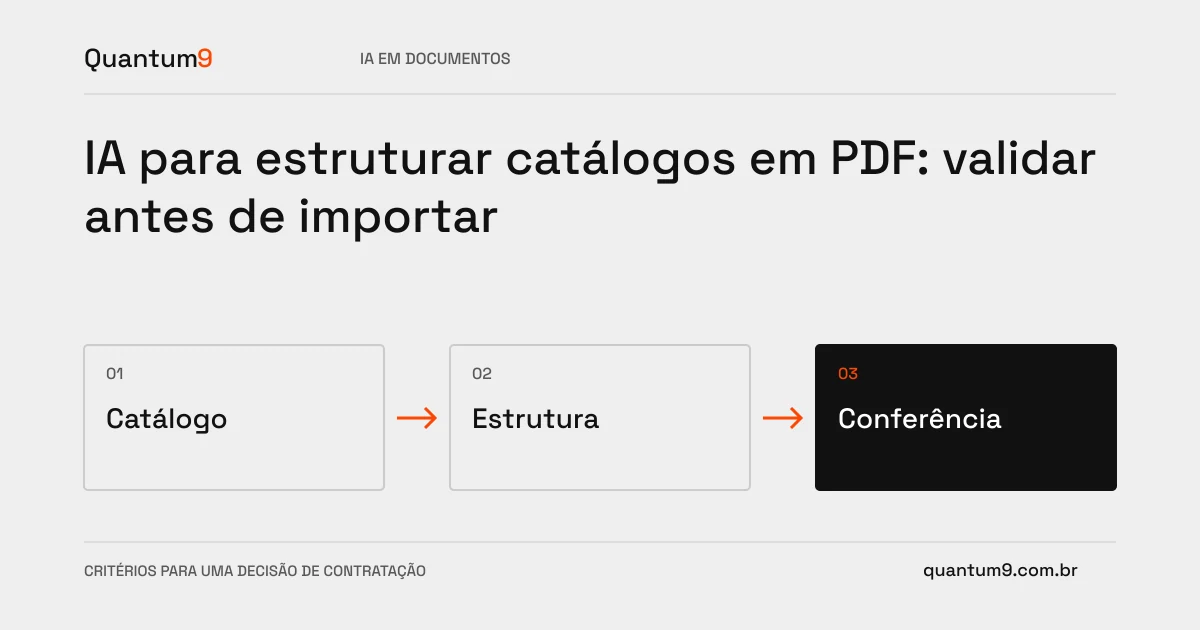
- Conference: review fields of greatest impact and record corrections before import.
- Load: validate duplicity and compatibility with the official registry, preserving the source file.
A scenario to discuss with the supplier
Hypothetical example: A footnote changes the specification of only one variant. The process needs to relate this exception to the corresponding item, rather than applying the rule to the entire family.
What to validate upon delivery
Use a sample with complex tables and notes. Compare fields and links with a human check and test the import in a controlled environment before updating the productive catalog.
Prepare the conversation about the project
Take authorized files, registration template and critical fields to Quantum9. The budget must consider review and integration, in addition to extraction, to produce data that the operation can use.
AI for processes · Map the company's priority