
Index
Classifying documents works best when the categories have clear operational meaning. A taxonomy with overlapping classes produces divergence even among human reviewers, before any AI model.
How to evaluate this decision
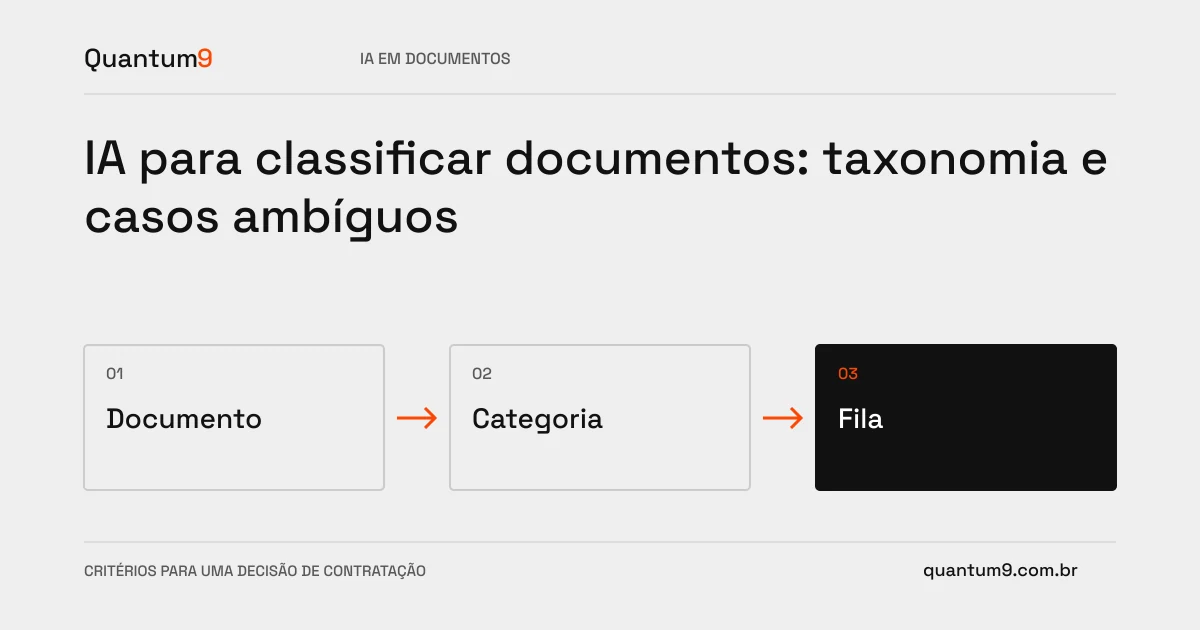
Define categories, examples, and exclusion criteria. Allow unknown or revision required when the document doesn't fit. Differentiate classification of the entire file from identification of internal pages or attachments. The result must guide a queue or concrete action, with the capacity to correct and learn from the errors observed.
Criteria for comparing proposals
- Taxonomy: documenting differences between nearby classes and who approves new categories.
- Sample: include representative formats, sources and visual quality.
- Exception: forward ambiguity without forcing a classification that triggers an inappropriate action.
A scenario to discuss with the supplier
Hypothetical example: a PDF contains a proposal and a contract in the same file. Classifying it exclusively as a proposal may send the set to the wrong queue; the scope needs to provide for compound documents.
What to validate upon delivery
Evaluate errors by class and consequence, not just a general rate. Check that rare categories and out-of-scope documents receive safe and understandable treatment.
Prepare the conversation about the project
Quantum9 can build triage and integrate work queues. Bring current categories, anonymized examples, and actions associated with each class to design a verifiable pilot.
AI for processes · Map the company's priority