
Index
A discovery is worth the investment when it reduces an uncertainty that prevents a relevant decision. Meetings and screens alone do not demonstrate that the project has become more viable or clearer.
How to evaluate this decision
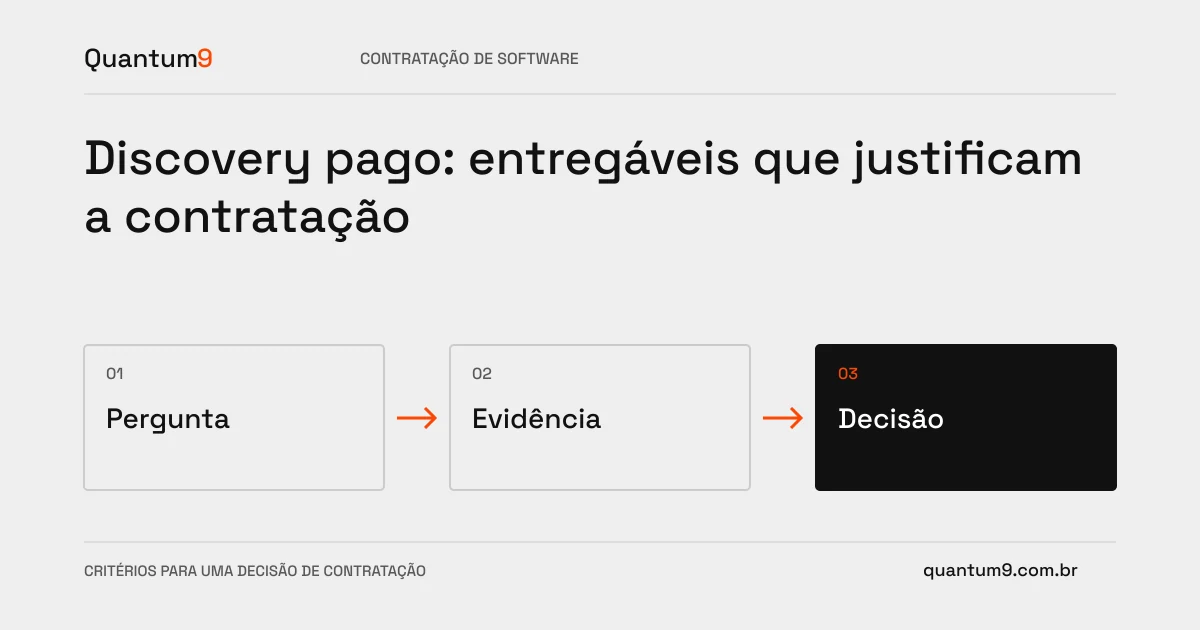
Define the input question: is there demand, can the process change, is an integration viable or does the scope fit the investment? Each question requires different evidence. Interviews help understand behavior; a technical proof tests a dependency; a prototype allows you to observe understanding. Hiring all these activities without a defined decision increases the effort without necessarily improving the choice.
Criteria for comparing proposals
- Evidence: require recording of observed problems and sample limitations, preserving participants' personal data.
- Alternatives: compare possible paths, including adjusting an existing tool or not developing it at that time.
- Output: receive priorities, risks, pending hypotheses and an estimable cut-off for the next cycle.
A scenario to discuss with the supplier
Hypothetical example: a company wants an app because it receives incomplete orders. Discovery can show that a CRM-integrated form solves most of the problem first. Useful delivery is the informed decision, even if the application does not move forward.
What to validate upon delivery
In the final presentation, ask for each recommendation to be linked to evidence. Check which hypotheses remain open and whether another team could use the materials to estimate the next step. A generic list of features is not enough.
Prepare the conversation about the project
To hire discovery with Quantum9, describe the blocked decision, who uses the process, who approves the investment and what data already exists. Also agree on what will not be investigated and the criteria for ending the stage.
Software engineering · Map the company's priority