
Index
Hiring ongoing capacity requires outcome governance. Counting tasks completed or hours logged does not reveal whether the work reduced a bottleneck or delivered a usable improvement.
How to evaluate this decision
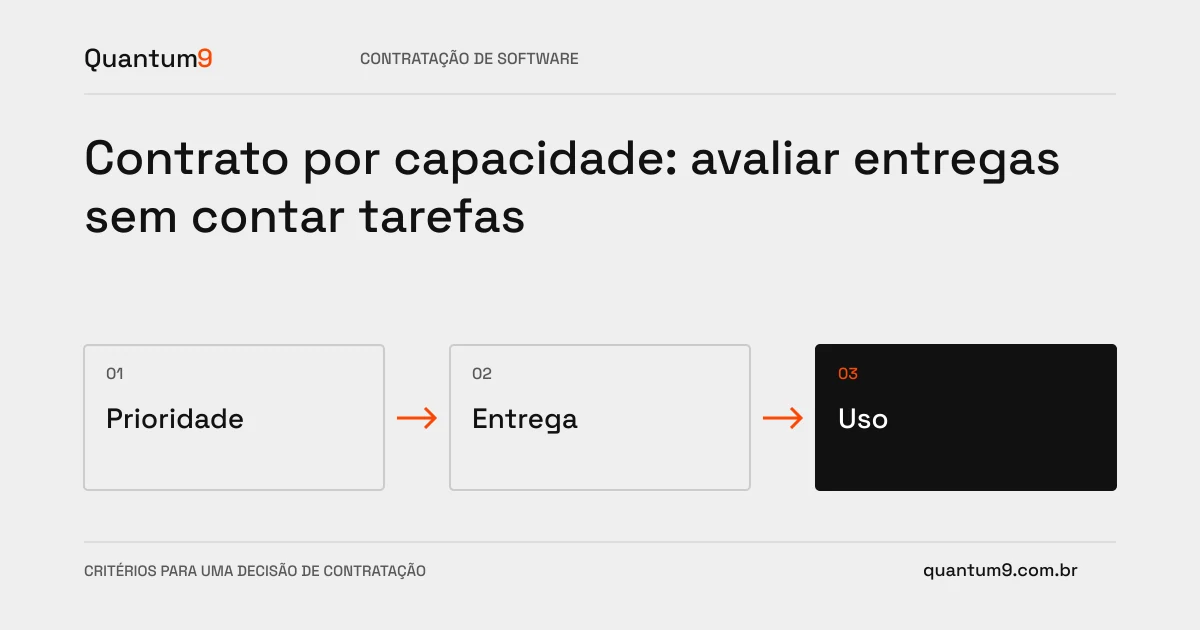
Set one objective per cycle and maintain explicit priorities. A small task and a complex integration cannot be compared by quantity. Track time between start and use, impediments, corrections after delivery and evidence of adoption. Hired capacity needs to consider meetings, support, and discovery, avoiding the expectation that every time it will turn directly into published functionality.
Criteria for comparing proposals
- Planning: limit simultaneous work and record who decides when two areas compete for priority.
- Transparency: distinguish items delivered, being validated, blocked and discarded, with a traceable reason.
- Quality: Include testing, documentation, and fixes in the meaning of done, rather than pushing them into another contract.
A scenario to discuss with the supplier
Hypothetical example: a cycle delivers fewer tasks because it resolves an import that was blocking the operation. The evaluation must consider the flow released and the stability of the delivery, not penalize the team for a lower count.
What to validate upon delivery
Review a working demonstration and agreed indicators at the end of the cycle. Check if pending issues are responsible and if the next priority is justified. Activity reports can support the conversation, but are not a substitute for proof of delivery.
Prepare the conversation about the project
When discussing ongoing evolution with Quantum9, inform the objective, the current queue and the availability of someone to decide and approve. Hiring needs to connect capacity, priority and responsibility; directionless allocation does not solve this.
Software engineering · Map the company's priority