
How to reduce risk in legacy systems with an impact-driven incremental roadmap.
Index
Modernize without stopping operations
Legacy applications generate invisible costs: incidents, evolution blocks and dependence on few developers. Effective modernization starts with what hurts the most for the business, not with what is technically “beautiful”.
1. Legacy X-ray
Map modules by risk/impact: security, stability, concentrated knowledge and external dependencies. Choose 1–2 high-impact targets for the first phase.
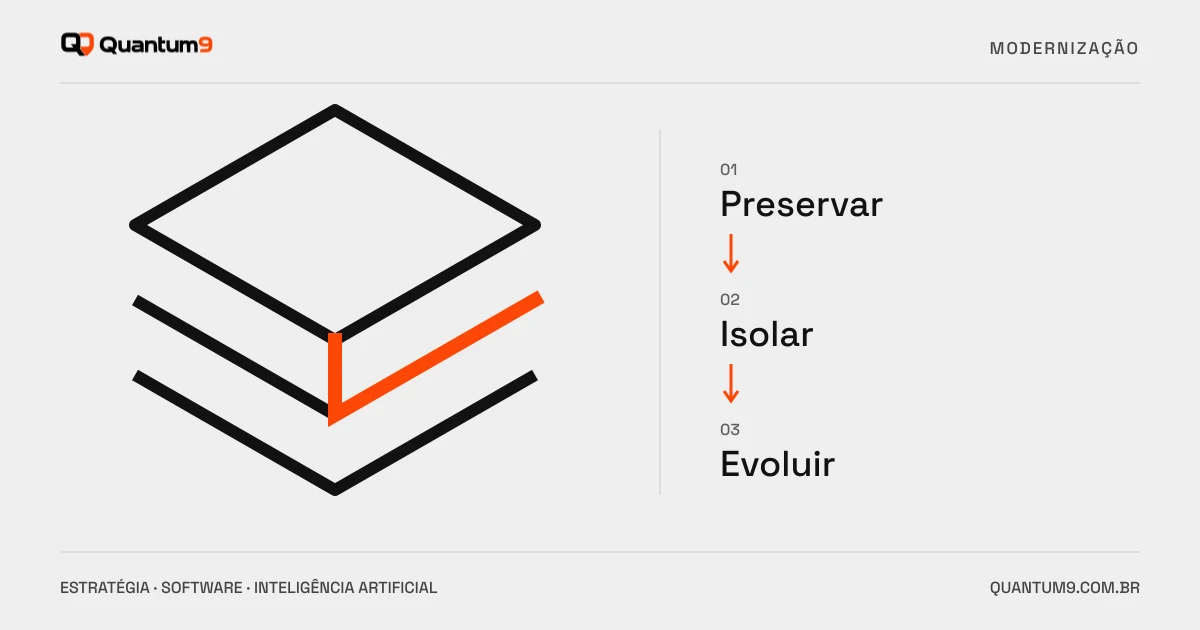
2. Wraps (strangler)
Create an API layer in front of the legacy one and gradually migrate functionality. Avoid “big bang” rewriting.
3. Automation and testing
Minimal regression test suite + synthetic critical flow monitoring. Without this, every release is a leap in the dark.
4. Cycle evolution plan
- Weeks 1–2: diagnosis and goals.
- Weeks 3–6: first module extraction + observability.
- Weeks 7–8: hardening, runbooks and handoff.
Do you want a modernization plan? We structure a diagnosis and a roadmap prioritized according to the criticality of the system.
How to turn the topic into a hiring decision
The modernization timeframe depends on inventory, rules, and integrations. The historical name of this URL does not represent a promise of completion in 60 days. Choose a module whose risk and boundary can be understood.
What to include in the scope
Map hidden tasks, reports, and manual procedures. Preserve calculation examples and expected results. Plan temporary coexistence between new and old parties, with an official source for information.
How to check delivery
Compare results before and after, test feedback and validate with users of the operation. A new interface without rule equivalence can create regressions that are difficult to detect. Data migration requires its own conference.